

The core is an important part of the mold. Its function is to form the inner cavity and holes of the casting, to shape undercuts, and to produce parts of the mold that have special requirements.
A core should meet the following requirements: the shape, dimensions, and position of the core in the mold should conform to the casting requirements; it should have sufficient strength and rigidity; gases generated during casting should be discharged in time; resistance to contraction of the casting should be small; operations such as core making, drying, assembling, and cleaning should be convenient; the core box structure should be simple.
Types of Cores and Their Applications
Cores can be classified according to the materials used for making them:
1. Sand Core
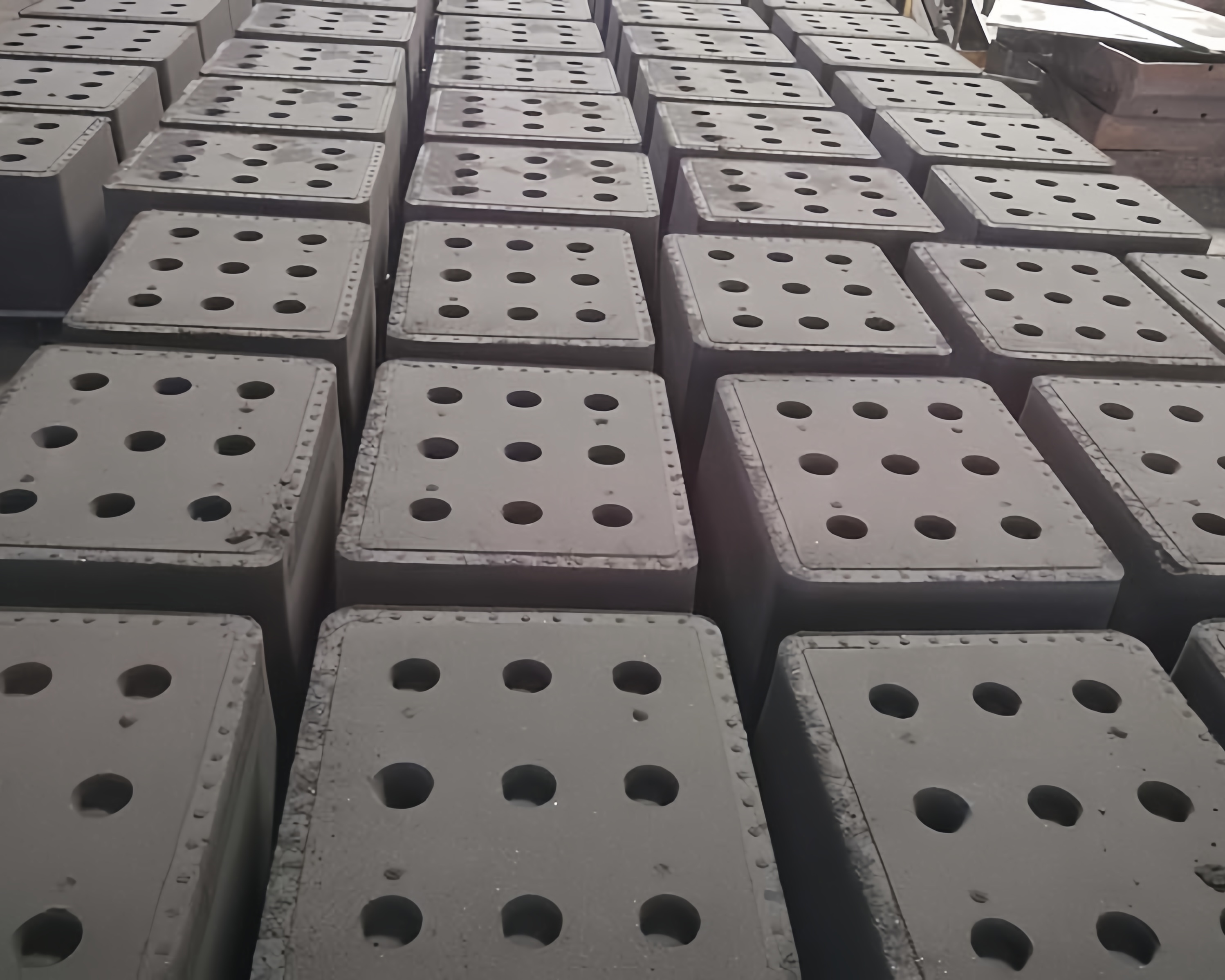
A core made of silica sand and similar materials is called a sand core. Sand cores are easy to manufacture, inexpensive, and can be used to produce various complex shapes. The strength and rigidity of sand cores generally meet the requirements, they impose little resistance to casting shrinkage, and they are easy to clean, so they are widely used in sand casting. In metal mold casting, low-pressure casting, and other processes, sand cores are also used for forming complex internal cavities and holes.
2. Metal Core
In permanent mold casting and die casting processes, metal cores are widely used. Metal cores have good strength and rigidity, and castings produced with them have high dimensional accuracy. However, they impose large resistance to casting shrinkage, and for complex cavities, core removal can be difficult. Care should be taken when selecting this type of core.
3. Soluble Core
Cores made of water-soluble salts, or cores bonded with water-soluble salts, are called soluble cores. These cores have high strength at room and elevated temperatures, low gas evolution, and good anti-penetration properties. During cleaning, they can be easily dissolved in water. Soluble cores are used to some extent in sand casting, permanent mold casting, and die casting processes.
Basic Principles of Sand Core Partitioning
Once the pouring position and parting line of the casting are determined, the structure of the casting can be used to decide how the sand core should be partitioned (i.e., whether the sand core should be made as a whole or in assembled sections) and what the shape of each section should be. The general principles are: to facilitate core making and core setting, ensure dimensional accuracy of the internal cavity, avoid defects such as blowholes, and keep the core box structure simple.
1. Ensuring Dimensional Accuracy of the Cavity
For parts of the casting that require high dimensional accuracy, the cavity should be formed by the same sand core, and it is generally undesirable to divide it into multiple cores. However, for large cores, in order to ensure accuracy in certain areas, partitioning may be necessary.
2. Facilitating Operations
Large and complex sand cores, or long and slender cores, may be divided into smaller and simpler cores. By dividing large and complex cores, the structure is simplified and manufacturing becomes easier. Long and slender cores may be divided into sections, and efforts should be made to make core boxes interchangeable. Thin connecting parts or cantilever projections of sand cores should be made separately, dried, and then glued and assembled.
3. Providing Wide Ramming Surfaces and Flat Drying Supports
Wide ramming surfaces make it convenient to install core reinforcement and to pack sand into the core box. For large cores to be dried in a furnace or for complex-shaped cores, they are often divided along the maximum cross-section into two halves. This not only provides wide ramming surfaces but also ensures flat supporting surfaces during drying.
In addition to the above, each sand core block should have a sufficiently large cross-section to guarantee strength and rigidity, allow smooth venting of gases, and maintain a simple core box structure for ease of manufacture and use.
Design of Core Prints
Core prints refer to the parts of the sand core that extend beyond the casting and do not come into contact with molten metal. They do not form the contour of the casting itself. The functions of core prints include positioning, supporting, and venting, though they may not serve all these purposes at the same time.
The requirements for core prints are: to position and fix the sand core accurately within the mold, to bear the core’s own weight and the buoyancy of molten metal during pouring so that the core is not damaged; to allow gases generated in the core after pouring to be vented outside the mold; to ensure upper and lower core prints, as well as core numbers, are easy to identify so that the core orientation and numbering are not mistaken; to make core placement and mold assembly convenient, core prints should have proper draft angles and clearances—the clearances must account for manufacturing tolerances of both the core and the mold, while minimizing flash; and to make storage, handling, and stacking of cores stable.
Core prints can be divided into two main types: vertical core prints and horizontal core prints (including cantilevered core prints).
Post time: Aug-21-2025