

The mechanical properties of castings are important indicators of the quality of most castings and are often used as the basis for acceptance. However, it is very difficult and usually impossible to apply the same load to the castings as the working conditions to measure their mechanical properties.
In fact, in most cases, the mechanical properties of castings are tested on samples that are assumed to be similar to the castings, and then the mechanical properties of the castings are inferred based on the test results of the samples.
In order to correctly evaluate the mechanical properties of castings, it is very important to prepare samples reasonably and conduct performance tests accurately.
Three methods for sampling samples for measuring the mechanical properties of castings:
1. Cutting samples from the casting body
The samples are cut from the specified part of the casting (generally selected from the part with the greatest force on the casting), which can more realistically reflect the mechanical properties of the casting itself at that part. However, the disadvantage of this method is that it will damage the casting and it is also difficult to manufacture, so it can only be used in limited situations. For example: to accurately judge the performance during the trial production process; in mass production, when the casting quality is stable, it is used for sampling inspection; when it is possible to cut samples on the casting, etc.
2. Samples cast together with castings (attached cast samples)
In order not to damage the casting body, the sample and the casting can be cast in the same mold. Like the casting, the sample is connected to the pouring system or is a continuation of a specified part of the casting (such as a rib). The results obtained by the former are not much different from those of the single cast sample, while the latter can approximately reflect the performance of the casting itself.
But in fact, due to the different mass and cross-sectional dimensions of the sample and the casting, their solidification and cooling rates are also different, so that even under the same casting heat treatment conditions, the mechanical properties of the sample and the casting are still different.
Therefore, attached cast samples are only recommended when the sample and the casting can achieve the same cooling rate. In general, attached cast samples are rarely used.
3. Separately cast samples
Since the above two methods have their own advantages and disadvantages, in the production process, when there are no special regulations, for the sake of simplicity, the method of separately cast samples is generally adopted. According to the test results obtained from the separately cast samples, the mechanical properties of the casting can be roughly inferred.
It should be noted that the process of casting the sample separately must conform to the casting process of the casting, so as to eliminate the influencing factors of various accidental changes as much as possible, and obtain a sample that can basically reflect the actual situation of the casting.
Commonly used methods for testing the mechanical properties of castings (alloys)
Tensile test method
Tensile test is one of the most important test items for the mechanical properties of castings. When conducting tensile tests, it is generally carried out in accordance with the standard GB/T 228.1-2010 "Metallic materials-Tensile testing-Part 1: Method of test at room temperature".
Impact test method
Impact test is one of the mechanical properties that many castings (alloys) need to test. When conducting impact tests, it should generally be carried out in accordance with the standard GB/T 229-2007 "Metallic materials-Charpy pendulum impact test method" at room temperature.
Hardness test method
Hardness test can test the hardness of castings (alloys) and sensitively reflect the differences in chemical composition and organizational structure of castings (alloys).
The hardness commonly tested for castings (alloys) includes Brinell hardness (HBW), Rockwell hardness (HRC or HRB, HRA, etc.), Vickers hardness (HV), Shore hardness (HS), Leeb hardness (HL), etc. When conducting hardness tests, the standards GB/T 231.1-2009 "Metallic materials—Brinell hardness test—Part 1: Test method", GB/T 230.1-2009 "Metallic materials—Rockwell hardness test—Part 1: Test method (scales A, B, C, D, E, F, G, H, K, N, T", GB/T 4340.1-2009 "Metallic materials—Vickers hardness test—Part 1: Test method", GB/T 4341-2001 "Metallic materials—Shore hardness test method" and GB/T 17394-1998 "Metallic materials—Leeb hardness test method".
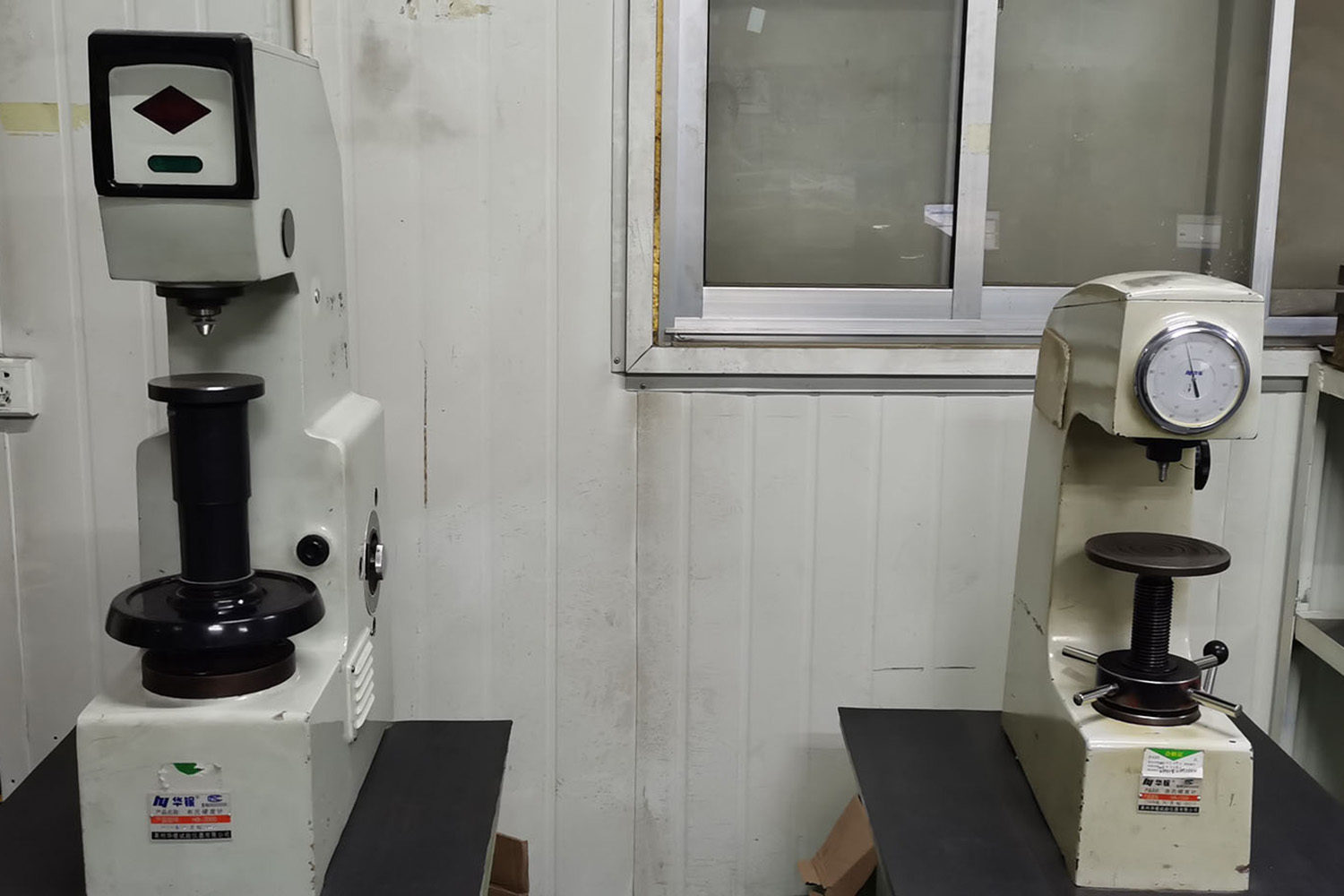
Characteristics and selection of hardness test methods
Brinell hardness
1) The indentation is large, and the measured hardness value is representative and repeatable, but it is not suitable to test on the surface of finished castings.
2) The indenter or test force needs to be changed for samples of different hardness and thickness, and the test operation and indentation measurement are time-consuming.
For castings (alloys) with a hardness value below 650HBW, if the surface allows a larger indentation (or the indentation can be removed after processing), and its geometry, size, and hardness are suitable for testing with a Brinell hardness tester, a Brinell hardness tester should be used. And the corresponding load should be selected according to different materials and thicknesses. In order to make the test results more accurate, a larger load and a larger steel ball diameter should be used as much as possible under permitted conditions.
Rockwell hardness
1) Easy and quick operation, the hardness value can be read directly on the dial or optical projection screen.
2) Different scales can be used to measure the hardness of various metals with different hardness and different thicknesses.
3) The measurement error is large and not accurate enough; the indentation is small, the representativeness is poor, the repeatability is poor, and the dispersion is large.
4) The hardness values measured by different scales have no relationship with each other and cannot be directly compared.
If the casting (alloy) is large in size and does not allow large marks, and its geometric shape is suitable for Rockwell hardness machine testing, the Rockwell hardness machine (980N load) can be used for testing.
Vickers hardness
1) The test force can be selected arbitrarily, and the hardness of samples of different thicknesses can be measured.
2) It can measure different hardnesses of soft and hard, and has a clear indentation that is comparable. It is the most accurate hardness test method.
3) Low work efficiency. If there is segregation or uneven structure, the repeatability is poor and the dispersion is large.
For castings (alloys) with very high hardness or small cross-sections (although the hardness is not high) and carburized layers, nitrided layers, and metal coatings with very thin surface layers, when hardness tests cannot be performed on Brinell or Rockwell hardness machines, Vickers hardness machines can be used for testing.
Shore hardness
1) Simple and convenient operation, high test efficiency.
2) Small indentation, can be tested on the surface of finished castings, and can also be measured on site for the surface hardness of large castings.
3) Low measurement accuracy, poor repeatability, and greatly affected by human factors; for materials with large differences in elastic modulus, the measured hardness cannot be compared with each other.
Can be used for roll castings and large castings.
Leeb hardness
1) Simple and convenient operation, high test efficiency.
2) Small indentation, can be tested on the surface of finished castings, and can also be measured on site for the surface hardness of large castings.
3) High requirements for the operator's test technology.
4) The conversion relationship between Leeb hardness and other hardness is only approximate, and a special conversion table should be used for accurate conversion.
Can be used for various castings (alloys).
Post time: Jun-26-2025